10 Benefits of Montessori Education for Young Children
Choosing the right educational approach for your child is an important decision. Parents today have many options, but Montessori Education stands out for its focus on independence, curiosity, hands-on learning, and the natural development of each child.
Rather than simply asking children to memorize information, the Montessori approach encourages them to explore concepts through meaningful activities and carefully prepared learning environments.
If you’re considering Montessori for your child, here are 10 benefits of Montessori Education for young children.
1. Encourages Independence
One of the core principles of Montessori Education is helping children become more independent.
Children are encouraged to complete age-appropriate tasks on their own, such as choosing activities, organizing materials, cleaning up, and caring for their environment.
These small responsibilities can help children develop confidence and a sense of accomplishment.
2. Builds Confidence and Self-Esteem
Montessori classrooms provide children with opportunities to learn at their own pace and practice skills repeatedly.
When children successfully complete an activity independently, they experience the satisfaction of solving a problem themselves. Over time, these experiences can help build confidence and encourage children to take on new challenges.
3. Encourages Curiosity and a Love of Learning
Young children are naturally curious. Montessori environments are designed to encourage that curiosity.
Instead of making learning feel like a task, Montessori activities invite children to explore, experiment, observe, and discover.
This can help create a positive attitude toward learning that extends beyond the classroom.
4. Supports Hands-On Learning
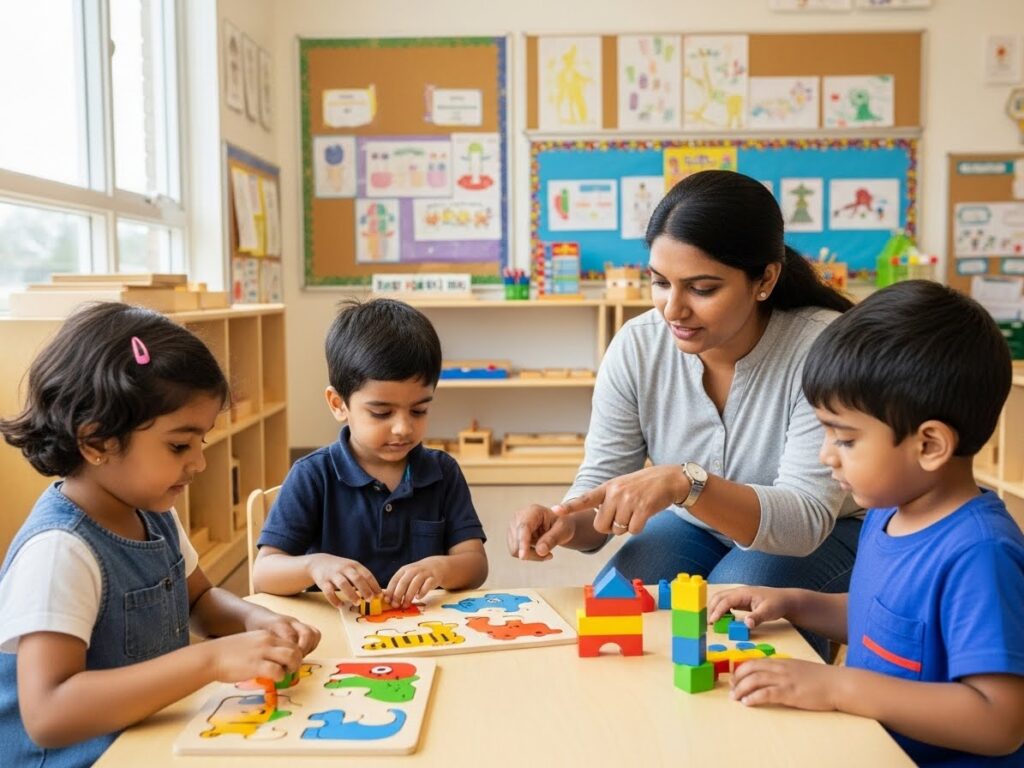
A major feature of Montessori Education is hands-on learning.
Children often use specially designed materials to explore concepts involving numbers, language, shapes, patterns, coordination, and everyday practical skills.
Hands-on activities can make abstract ideas easier for young children to understand because they can see, touch, and interact with what they are learning.
5. Develops Concentration and Focus
Montessori classrooms often give children uninterrupted periods to work on activities that interest them.
Instead of constantly moving from one activity to another, children can spend meaningful time completing a task.
This approach can help young learners gradually develop concentration, patience, and the ability to focus on an activity.
6. Promotes Problem-Solving Skills
Montessori activities often encourage children to think through challenges rather than immediately relying on an adult for the answer.
Children can experiment with materials, identify mistakes, try different approaches, and discover solutions.
Developing these problem-solving skills during early childhood can support learning in many areas as children grow.
7. Encourages Social and Emotional Development
Although Montessori learning supports individual exploration, children also interact with classmates and teachers throughout the day.
They can learn important social skills such as:
- Sharing space with others
- Communicating respectfully
- Waiting for a turn
- Cooperating with classmates
- Resolving everyday disagreements
- Respecting other people’s work
These experiences can help children develop emotional awareness and positive social habits.
8. Supports Individual Learning Needs
Every child develops differently. One child may quickly understand numbers, while another may show a stronger interest in language, art, or practical activities.
Montessori Education allows children to work with activities that match their developmental stage and interests.
This individualized approach can give children the opportunity to practice skills without feeling pressured to progress at exactly the same pace as everyone else.
9. Teaches Responsibility Through Everyday Activities
Montessori education doesn’t limit learning to traditional academic subjects.
Children can also participate in practical activities such as organizing materials, caring for plants, preparing simple tasks, and maintaining their learning environment.
These activities can help children understand responsibility while developing coordination, independence, and practical life skills.
10. Creates a Positive Foundation for Lifelong Learning
Perhaps one of the most valuable benefits of Montessori Education is that it aims to develop more than academic knowledge.
Children are encouraged to become curious, independent, responsible, and confident learners.
By creating positive early experiences with learning, Montessori education can help children develop habits and attitudes that support their educational journey as they grow.
Why Choose Montessori Education for Your Child?
Every child is unique, and there is no single educational approach that works exactly the same way for every family.
When considering a Montessori program, parents should look at the learning environment, teachers, classroom practices, safety standards, daily routines, and how the program supports children’s individual development.
Visiting the school and speaking with educators can also help parents understand whether the approach is a good fit for their child.
Discover First Step
If you’re exploring educational options for your young child, Discover First Step and learn more about an environment designed to support curiosity, independence, creativity, and a positive approach to learning.
A thoughtfully implemented Montessori Education program can give children opportunities to learn through exploration, hands-on experiences, and meaningful everyday activities.
Take the first step toward discovering an engaging early learning experience for your child.