What Is Montessori Education? A Complete Guide for Parents
Choosing the right educational approach for your child is one of the most important decisions parents make. With so many teaching methods available today, it can be difficult to understand which approach best supports a child’s development. Montessori Education is one approach that has gained worldwide recognition for encouraging independence, curiosity, confidence, and hands-on learning.
But what exactly is Montessori Education, and how does it work?
In this complete guide, we’ll explain the Montessori method, its key principles, benefits, classroom environment, and what parents should consider when choosing a Montessori school.
What Is Montessori Education?
Montessori Education is an educational approach developed by Italian physician and educator Dr. Maria Montessori. It is based on the idea that children learn naturally through exploration, hands-on experiences, and meaningful activities.
Rather than relying primarily on traditional lectures and memorization, Montessori classrooms provide children with specially designed learning materials and opportunities to choose activities based on their interests and developmental needs.
The teacher acts as a guide, observing children and introducing activities when they are ready to learn them.
The goal is to help children become independent, confident, curious, and lifelong learners.
How Does Montessori Education Work?
A Montessori classroom is designed to encourage children to learn through doing.
Children may work individually or in small groups with carefully designed materials. Activities can involve practical life skills, language, mathematics, sensory exploration, culture, and more.
Some important characteristics of Montessori Education include:
- Hands-on learning: Children learn concepts through physical interaction with materials.
- Child-led activities: Children are often given choices about which appropriate activity they want to work on.
- Independent learning: Children are encouraged to complete tasks independently whenever they are capable.
- Mixed-age classrooms: Many Montessori environments include children from different age groups.
- Prepared environment: Classrooms are organized so children can access appropriate materials and participate independently.
- Teacher as a guide: Teachers observe, demonstrate, and support rather than directing every activity.
- Learning at an individual pace: Children can receive opportunities suited to their developmental stage.
What Are the Main Principles of Montessori Education?
1. Learning Through Hands-On Experiences
Montessori Education emphasizes learning by doing. Instead of simply being told how something works, children can interact with materials and discover concepts through experience.
For example, a child learning mathematics may use physical counting materials before moving toward more abstract mathematical concepts.
2. Independence
One of the central goals of Montessori is helping children become increasingly independent.
Simple classroom activities such as putting away materials, preparing a snack, watering plants, or organizing personal belongings can help children develop responsibility and confidence.
3. Freedom Within Limits
Montessori classrooms give children choices, but that freedom exists within clear boundaries.
Children are expected to use materials appropriately, respect other people, maintain the classroom environment, and follow established routines.
This balance helps children develop both independence and self-discipline.
4. Respect for the Child
Montessori Education places strong emphasis on treating children with respect.
Adults listen to children, recognize their individual needs, and provide opportunities for them to participate actively in their own learning.
5. A Prepared Environment
The classroom environment is carefully arranged to make learning accessible.
Furniture and learning materials are generally designed to be suitable for children, allowing them to select, use, and return materials with increasing independence.
What Does a Montessori Classroom Look Like?
A Montessori classroom may look different from a traditional classroom.
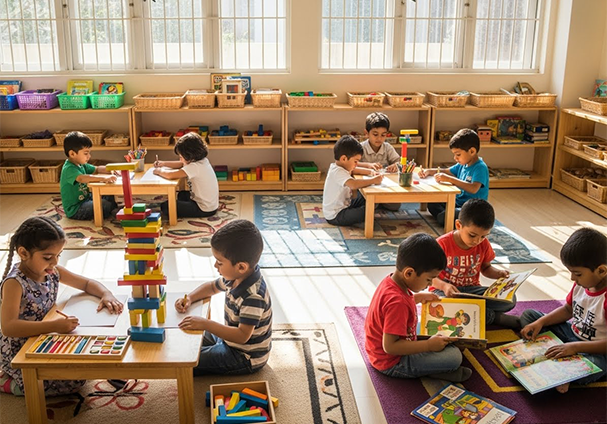
Instead of rows of desks facing a teacher, you may see shelves containing carefully arranged learning materials, child-sized furniture, work tables, floor mats, and clearly defined activity areas.
The environment may include areas dedicated to:
- Practical life
- Sensorial development
- Mathematics
- Language
- Culture and science
- Art and creative activities
The classroom is designed to encourage concentration, movement, exploration, and independent work.
What Do Children Learn in Montessori Education?
Montessori Education supports several areas of a child’s development.
Practical Life Skills
Children may learn everyday skills such as:
- Pouring and transferring
- Buttoning and zipping
- Cleaning
- Folding
- Food preparation
- Caring for plants
- Organizing belongings
These activities can help develop coordination, concentration, independence, and responsibility.
Sensorial Learning
Montessori sensorial materials help children explore concepts such as size, shape, color, texture, sound, and weight.
These activities provide children with opportunities to observe differences and similarities and organize information.
Language
Language activities may include vocabulary development, phonetic awareness, reading, writing, storytelling, and communication.
Children are gradually introduced to language concepts according to their developmental readiness.
Mathematics
Montessori mathematics often begins with concrete materials. Children can physically explore quantities, numbers, patterns, and mathematical relationships before progressing toward more abstract concepts.
Culture and Science
Children may explore geography, nature, science, history, art, and different cultures.
These activities can encourage children to ask questions and develop an interest in the world around them.
What Are the Benefits of Montessori Education?
Every child is different, and outcomes can depend on the school, teachers, environment, and individual child. However, Montessori Education is designed to support several important developmental qualities.
Encourages Independence
Children are given opportunities to perform age-appropriate tasks independently rather than having adults do everything for them.
Builds Confidence
Completing meaningful activities independently can help children develop a sense of capability and confidence.
Supports Concentration
Montessori environments often provide uninterrupted periods in which children can focus on activities. This can help them practice sustained attention.
Develops Problem-Solving Skills
Children can explore materials, make observations, correct mistakes, and try again.
Encourages Curiosity
Instead of focusing only on memorizing information, Montessori learning encourages children to explore and discover.
Supports Social Development
Mixed-age environments and collaborative activities can provide opportunities for children to communicate, cooperate, observe others, and develop social skills.
Is Montessori Education Suitable for Every Child?
There is no single educational approach that is perfect for every child or family.
Some children may thrive in an environment that provides independence, hands-on learning, and freedom within clear boundaries. Other children may prefer or benefit from different classroom structures.
Parents should consider factors such as:
- Their child’s personality and learning needs
- The school’s Montessori approach
- Teacher qualifications and experience
- Classroom environment
- Student-to-teacher ratio
- Communication between school and parents
- Daily routines
- The school’s educational philosophy
Visiting a school and observing a classroom can be one of the best ways to understand whether its approach feels suitable for your child.
What Should Parents Look for in a Montessori School?
When exploring Montessori schools, don’t focus only on the word “Montessori” in the school’s name. Look at how the philosophy is actually implemented.
Parents can ask:
- How are teachers trained in Montessori Education?
- How are children encouraged to become independent?
- What learning materials are available?
- How does the school handle different learning paces?
- What is the classroom age range?
- How does the school communicate with parents?
- How much time do children spend on uninterrupted learning activities?
- How are discipline and classroom boundaries handled?
- How does the school support each child’s individual development?
A school visit can also help parents see whether the classroom is calm, organized, welcoming, and appropriately prepared for children.
Montessori Education and Parents: A Partnership
Montessori learning doesn’t have to stop when children leave the classroom.
Parents can support similar principles at home by giving children opportunities to participate in everyday activities.
Depending on their age, children can help with:
- Putting away toys
- Choosing between appropriate clothing options
- Preparing simple food
- Watering plants
- Cleaning up after activities
- Organizing personal belongings
- Reading independently
- Helping with simple household tasks
The objective isn’t to expect children to do everything themselves. Instead, parents can provide age-appropriate opportunities to practice independence while offering support when needed.
Why Choose Discover First Step for Montessori Education?
If you’re exploring Montessori Education for your child, Discover First Step can be part of your search for an environment that supports children’s curiosity, independence, and development.
For parents, choosing a school is about more than academics. The learning environment, teachers, daily routines, communication, and approach to child development all matter.
Take time to learn about the school’s educational philosophy, visit the environment, ask questions, and understand how the Montessori approach is practiced in everyday learning.
Frequently Asked Questions About Montessori Education
What is Montessori Education in simple words?
Montessori Education is a child-centered educational approach that encourages children to learn through hands-on activities, exploration, independence, and carefully prepared learning environments.
What age is Montessori Education for?
Montessori programs can serve children from infancy through adolescence, depending on the school and program. The classroom environment and learning activities are adapted to children’s developmental stages.
Is Montessori better than traditional education?
Montessori and traditional education use different approaches to teaching and learning. Rather than assuming one method is universally better, parents should consider their child’s needs and evaluate the specific school, teachers, curriculum, and learning environment.
Does Montessori Education focus only on academics?
No. Montessori Education generally addresses multiple areas of development, including practical life skills, social development, language, mathematics, sensory development, independence, and cultural learning.
Can Montessori principles be used at home?
Yes. Parents can incorporate age-appropriate Montessori-inspired practices at home by encouraging independence, providing choices within boundaries, involving children in everyday tasks, and creating organized spaces where children can access appropriate activities.
Final Thoughts
Montessori Education offers a distinctive approach to childhood learning by giving children opportunities to explore, make choices, practice independence, and learn through hands-on experiences.
For parents, understanding the philosophy is the first step. The next step is to look closely at individual schools and see how their Montessori approach works in practice.
If you are considering Montessori schooling for your child, explore Discover First Step, ask questions, visit the learning environment, and choose an educational setting that aligns with your child’s developmental needs and your family’s expectations.